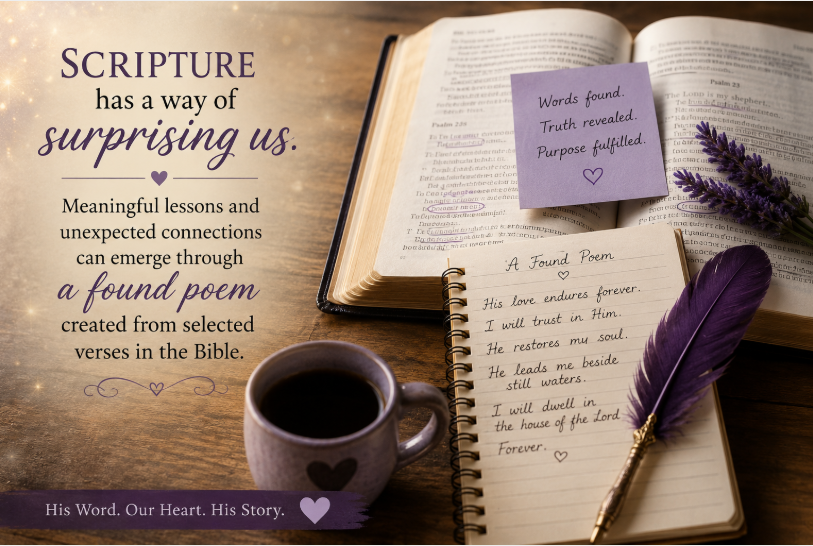
Scripture has a way of surprising us. Meaningful lessons and unexpected connections can emerge through a found poem created from selected verses in the Bible.
At times, a familiar verse reaches into the heart with fresh meaning. On other occasions, an unexpected passage rises at the right moment, bringing comfort, conviction, wisdom, or encouragement. Many believers can recall moments when God’s Word seemed to speak directly into a situation in a way that could not have been planned.
Several years ago, I came across something entirely different—a creative writing concept called a found poem. At the time, I had never intentionally created one and knew very little about the process. The idea immediately caught my attention.
For those unfamiliar with the term, a found poem is created by taking words, phrases, or passages from a source already written and arranging them into poetic form.
The source might come from literature, newspapers, speeches, letters, or everyday language. Instead of creating original wording, the poet “finds” language and shapes it into something newly expressed.
As someone who loves Scripture, my thoughts naturally turned to the Bible.
Could verses, selected from different places, somehow come together to form something meaningful?
I decided to try.
A Creative Exercise Rooted in Curiosity
Since this was my first experience with found poetry, I wanted to approach it differently. For the sake of the exercise alone, I randomly opened my Bible and placed my finger on selected verses, wondering what might emerge.
My purpose was not Bible study in the traditional sense, nor was I seeking answers or direction through random passages. I simply wanted to see whether seemingly unrelated Scriptures could connect within the framework of a found poem.
To be honest, I felt nervous.
The possibility existed that the result would sound scattered or disconnected. After all, how could verses chosen in this way possibly fit together in any meaningful manner?
Yet something unexpected happened.
A progression began to unfold.
The verses seemed to move naturally from one thought to another, almost as though they had quietly entered into conversation with each other. What started with spiritual maturity shifted toward service and compassion.
Human weakness appeared in the middle, followed by warnings about worldly corruption and misplaced values. Finally, the poem arrived at hope and renewal.
Even now, years later, I still find the flow intriguing almost as though the verses were selected intentionally.
Perhaps that is one reason Scripture remains timeless. Verses written centuries apart often echo one another in ways that continue to reveal deeper truths.
Below is the poem exactly as it was written.
Found Poem from the Bible
I am writing to you who are mature because you know Christ, the one who is from the beginning.
I have much to tell you, but I don’t want to do it in a letter.
Dear friend, you are doing a work for God when you take care of the travelling teachers, who are passing through, even though they are strangers to you.
Pure and lasting religion in the sight of God our Father means that we must care for orphans and widows in their troubles, and refuse to let the world corrupt us.
But his fellow servant fell down before him and begged for a little more time.
They are the kind who work their way into people’s homes and with the confidence of vulnerable women who are burdened with the guilt of sin and controlled by many desires.
The woman wore purple and scarlet clothing and beautiful jewelry made of gold and precious gems and pearls.
The merchants of the world will weep for her, for there is no one left to buy their goods.
Well, how much more do I need to say?
It will happen in a moment, in the blinking of an eye, when the last trumpet is blown.
And when the Lamb broke the fourth seal, I heard the fourth living beast say, “Come!”
And the one sitting on the throne said, “Look, I am making all things new!”
© Veron Lee Campbell
June 11, 2014
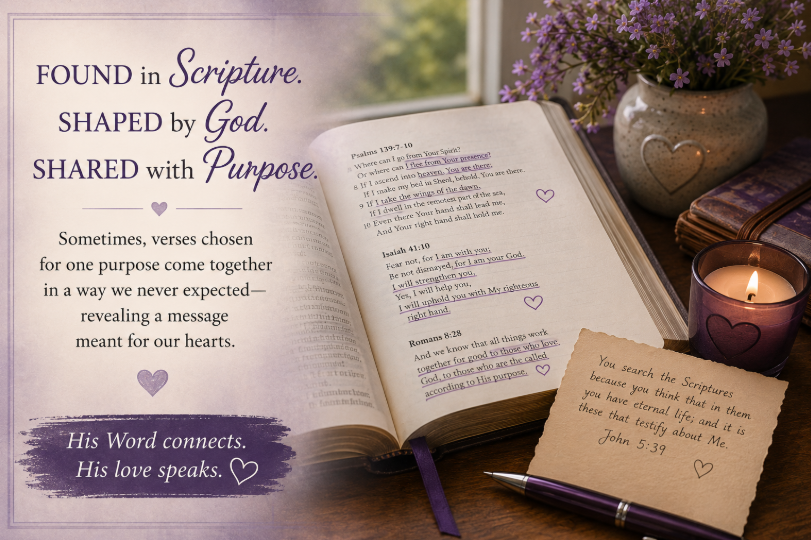
Scripture Speaks in Unexpected Harmony
Reading the poem again after so many years, I am struck by how naturally the verses seem to move together.
The opening speaks of spiritual maturity:
“I am writing to you who are mature because you know Christ…”
Growth in faith forms an important foundation. Spiritual maturity is not measured by how long someone has attended church or how much Scripture has been memorized.
Maturity develops through relationship with Christ, lived experience, wisdom, humility, and obedience.
Almost immediately, the tone shifts into care and service:
“You are doing a work for God when you take care…”
That verse resonates deeply with me because caring for others as a caregiver has shaped much of my own journey. Service often happens quietly, behind the scenes, unnoticed by most people.
Hospitality, kindness, compassion, and practical help matter more than society sometimes recognizes.
The poem continues with a reminder about what true faith looks like:
“Pure and lasting religion… means that we must care for orphans and widows in their troubles…”
Faith was never intended to remain inside church walls. Scripture repeatedly points toward compassion, integrity, and concern for people who are vulnerable or overlooked.
Caring for those who struggle reveals something about the posture of the heart.
Then comes an interesting turn.
The poem introduces human frailty:
“But his fellow servant fell down before him and begged for a little more time.”
How many moments in life resemble this?
People carry burdens unseen by others. Financial strain, emotional pain, regret, illness, disappointment, fear, and uncertainty. These can leave a person longing for more time, more grace, another opportunity to make things right.
Unexpected Harmony Continued
Without warning, the poem shifts again into caution:
“They are the kind who work their way into people’s homes…”
A sobering reminder emerges here. Vulnerability calls for wisdom. Scripture teaches compassion, yet also warns against manipulation, deception, and influences that quietly corrupt. Discernment remains essential.
Next arrives a picture of worldly attraction and excess:
“The woman wore purple and scarlet clothing…”
Followed by:
“The merchants of the world will weep for her…”
The imagery speaks of temporary systems, misplaced priorities, and the seductive pull of materialism. Wealth, influence, beauty, and success often appear permanent while remaining fragile.
Scripture continually reminds us that worldly treasures eventually fade.
Then one line unexpectedly stands almost like a pause in the middle of the poem:
“Well, how much more do I need to say?”
Whenever I read those words, I smile a little.
Placed within the poem, the sentence almost sounds conversational. It’s as though Scripture itself pauses and gently asks the reader whether the message has already become clear.
The final movement turns toward eternity:
“It will happen in a moment, in the blinking of an eye…”
“Come!”
And finally:
“Look, I am making all things new!”
What a beautiful way for the poem to end.
After warnings, brokenness, struggle, and uncertainty, renewal receives the final word. Ultimately, hope, restoration, and God remain.
The Lesson Hidden in Unexpected Connections
When I first attempted this found poem, I never imagined that verses chosen for a creative exercise would come together with such surprising coherence.
Even now, one lesson continues to stay with me: God often brings meaning out of what appears disconnected.
Life itself can feel fragmented with:
- Unexpected detours.
- Unanswered questions.
- Painful seasons.
- Moments that seem unrelated or difficult to understand.
Then, somehow, with time and perspective:
- Patterns begin to emerge.
- Connections appear.
- Purpose becomes clearer.
- Faith deepens.
In many ways, this little found poem reminds me of life itself.
- Pieces gathered unexpectedly.
- Moments that seem unrelated.
- A story quietly unfolding.
Most of all, it reminds me that Scripture continues to speak—not only through individual verses, but through patterns, themes, and truths woven throughout its pages.
A creative writing experiment in 2014 left me pleasantly surprised.
Interestingly enough, years before learning the term found poem, I had unknowingly experienced something similar while putting together the table of contents for a book of poems.
As I placed fourteen poem titles in sequence, an unexpected poem emerged—one I titled Confession of My Life.
Later, it became Part I of my book Confessions of My Life.
At the time, I did not recognize it as any particular literary form. I simply knew something meaningful had taken shape. What began as headings unexpectedly became poetry.
So, when I encountered the concept of found poetry, curiosity naturally followed.
Years later, I remain grateful for the reminder that meaningful connections sometimes emerge when we least expect them.
Perhaps that is part of the beauty of both writing and faith.
God still has a way of making all things new.
Veron | Business Owner | The Way 4Word Enterprises
- Share:
