“In the morning sow thy seed, and in the evening withhold not thine hand: for thou knowest not whether shall prosper, either this or that, or whether they both shall be alike good.” — Ecclesiastes 11:6 (KJV)
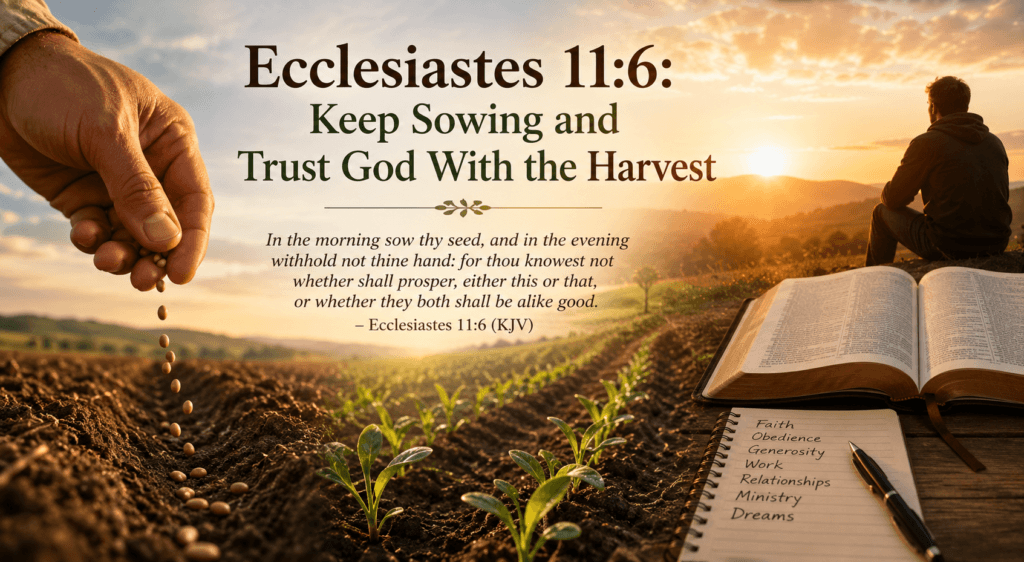
There is something both challenging and reassuring about these words from Ecclesiastes. They acknowledge a reality we sometimes struggle to accept: we do not always know which of our efforts will prosper.
We may sow our time, talents, resources, prayers, generosity, creativity, knowledge, or labor into something without knowing what the eventual outcome will be.
However, we would often prefer assurance before investing ourselves. It would be assuring to know that the seed will grow before we put it into the ground.
Ecclesiastes 11:6 offers a different approach. It instructs us to sow anyway.
Sow in the morning. Continue in the evening. Do what has been placed within your hands to do, even though you cannot see the harvest beforehand.
This is not a promise that everything we undertake will succeed. Neither is it an invitation to pursue every opportunity that comes our way without wisdom or discernment. Rather, it is a reminder of the limitations of human foresight and the importance of faithful action.
We are responsible for sowing. Ultimately, the harvest belongs to God.
Understanding Ecclesiastes 11:6 in Context
Ecclesiastes 11:6 becomes even more meaningful when we consider the verses leading up to it. Ecclesiastes 11:1–6 presents a series of observations about living and acting in a world where we cannot predict everything that will happen.
Here we will find:
- Encouragement to release rather than cling tightly to what we have.
- A reminder not to concentrate everything in one uncertain place.
- Warning against becoming so preoccupied with circumstances that we fail to act.
- A reminder that we cannot fully understand the works of God.
Then comes the instruction:
“In the morning sow thy seed, and in the evening withhold not thine hand.”
Uncertainty runs throughout the passage, but inactivity is never presented as the answer. Pay close attention to that lesson.
Not knowing what will happen does not necessarily mean we should do nothing. Sometimes it means we should faithfully do what we can while accepting that the outcome is beyond our control.
“Give a Portion to Seven, and Also to Eight”
Ecclesiastes 11:2 says:
“Give a portion to seven, and also to eight; for thou knowest not what evil shall be upon the earth.”
There is wisdom here in not placing everything into one uncertain outcome.
Although this principle can certainly apply to money and material resources, its wisdom can extend into many other areas of life.
We may have several abilities to develop, different opportunities to explore, people into whose lives we can sow, creative endeavors to pursue, ministries to support, or businesses to build.
However, we do not necessarily know which will bear the greatest fruit.
Diversifying our efforts does not have to mean being unfocused. There is a difference between chasing everything that attracts our attention and wisely stewarding the different gifts and opportunities God has entrusted to us.
Sometimes we may be tempted to believe that only one thing can prosper. Ecclesiastes does not make that assumption.
Don’t Spend Your Life Watching the Wind
One of the most striking verses in this passage is Ecclesiastes 11:4:
“He that observeth the wind shall not sow; and he that regardeth the clouds shall not reap.”
There will almost always be a wind to observe…
- The timing isn’t quite right.
- Resources aren’t sufficient.
- The economy is uncertain.
- Someone else seems more qualified.
- We need more information.
- We fear failure.
- Conditions may improve tomorrow.
Some of these concerns may be legitimate. Wisdom does not require us to ignore circumstances.
But there is a point at which caution can become paralysis.
If the farmer continually waits for perfect conditions, the seed may never enter the ground. And a seed that is never planted cannot produce a harvest.
We can do something similar with our lives. For instance, we may spend so much time evaluating what could go wrong that we never give anything an opportunity to go right.
Faith does not require pretending that the wind isn’t blowing. On the contrary, it means refusing to allow every uncertain wind to determine whether we sow.
We Cannot Know All the Works of God
Ecclesiastes 11:5 brings us directly to the limits of human understanding:
“As thou knowest not what is the way of the spirit, nor how the bones do grow in the womb of her that is with child: even so thou knowest not the works of God who maketh all.”
There are things God is doing that we simply cannot see or understand.
A seed beneath the soil may appear to be doing nothing. Yet beyond our sight, something may already be happening.
The same can be true of our efforts.
Something we consider insignificant today may become consequential years from now. A word spoken to someone may remain in that person’s memory long after we have forgotten saying it.
Work that seems to attract little attention may eventually reach exactly the person who needs it. A skill developed in one season may become invaluable in another.
We cannot always determine the future importance of what we are doing by its present appearance.
That is precisely what prepares us for verse 6.
Because we cannot know everything God is doing, we should not require complete knowledge before we are willing to act.
Sow in the Morning—and Keep Sowing
“In the morning sow thy seed, and in the evening withhold not thine hand.”
There is persistence in those words.
Plant the seed, but don’t assume that one act of sowing completes your responsibility. Continue using your hands. Keep working. Continue nurturing what has been entrusted to you.
We live in a world that often celebrates immediate results. If something doesn’t produce quickly enough, we may conclude that it isn’t working.
But sowing and harvesting belong to different seasons. The sequence is seed, time in between, then comes the harvest.
There are seeds we plant today whose fruit we may not recognize for years. Some may produce differently from what we expected. Others may lead somewhere we never anticipated.
We should therefore be careful about pronouncing something a failure simply because we cannot yet see its harvest.
You Don’t Know Which Will Prosper
Ecclesiastes 11:6 gives the reason for continued sowing:
“…for thou knowest not whether shall prosper, either this or that…”
We don’t know.
That may sound unsettling, but it can also be liberating.
We do not have to possess perfect foresight before moving forward. Nor do we have to know exactly which effort will produce the greatest result. And we don’t have to predict every outcome correctly.
What we expected to flourish may produce very little. Something we almost overlooked may become surprisingly fruitful.
Human beings are remarkably limited in our ability to predict which seeds will matter most.
That is why we should be cautious about deciding too early that something worthwhile has failed simply because it has not prospered according to our timetable.
Or Perhaps They Both Will
The final words of Ecclesiastes 11:6 are particularly easy to read past:
“…or whether they both shall be alike good.”
What if both prosper?
We sometimes create either-or decisions where God has not necessarily created them.
Which gift is the real one?
Which opportunity is supposed to work?
Which endeavor should I keep?
Which seed will produce the harvest?
There are certainly times when we must choose. There are seasons that end, doors that close, and responsibilities that require us to concentrate our attention.
But we should not automatically assume that God can prosper only one thing in our hands.
The verse leaves open another possibility: they may both be alike good.
That does not mean everything we attempt will prosper. Scripture makes no such promise. It means we cannot know beforehand which seed God may bless—or whether He may allow fruit to come from more than one.
Perhaps the question is not always, “Which one must I abandon?”
Sometimes the wiser question may be, “What has God given me to steward faithfully in this season?”
God Gives the Increase
The Apostle Paul provides an important balance in 1 Corinthians 3:6–7:
“I have planted, Apollos watered; but God gave the increase. So then neither is he that planteth any thing, neither he that watereth; but God that giveth the increase.”
Paul planted and Apollos watered. Both had work to do, but neither could manufacture the increase.
This keeps the message of Ecclesiastes 11:6 from becoming merely a philosophy of working harder until something succeeds. Biblical sowing is not about forcing a harvest through sheer effort.
There is work that belongs to us, and there is work that belongs to God.
We can plant, water, nurture, prepare, and persevere. But we cannot command the seed to grow.
God gives the increase.
Understanding that distinction can free us from both passivity and unnecessary pressure. We are not excused from doing our part, but neither are we required to control what only God can control.
Don’t Grow Weary Before Harvest Time
Galatians 6:9 offers another important reminder:
“And let us not be weary in well doing: for in due season we shall reap, if we faint not.”
There is a phrase here worth remembering: due season.
Our preferred season and God’s due season may not be the same.
Between planting and harvesting comes waiting. There may also be watering, cultivating, pruning, protecting, learning, correcting, and beginning again.
That middle season can become exhausting because it provides few visible signs of progress.
We may be tempted to abandon the field.
But what if the absence of visible fruit does not mean the absence of growth?
Ecclesiastes tells us to keep sowing. Galatians reminds us not to become weary while waiting for the appropriate season.
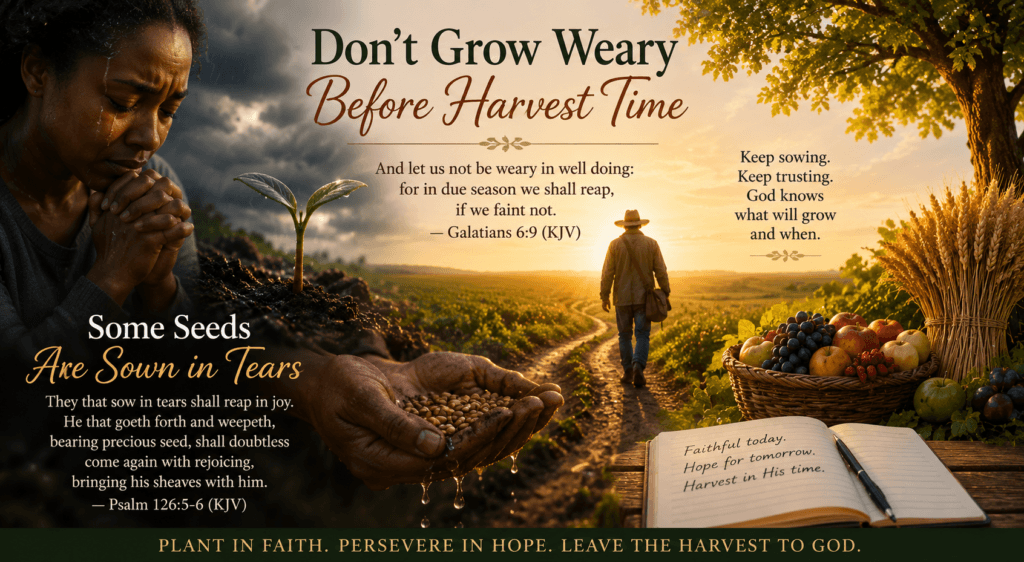
Some Seeds Are Sown in Tears
Psalm 126:5–6 adds yet another dimension:
“They that sow in tears shall reap in joy. He that goeth forth and weepeth, bearing precious seed, shall doubtless come again with rejoicing, bringing his sheaves with him.”
Not every seed is planted during a joyful season.
Some of our most meaningful seeds may be planted while we are hurting.
We may continue serving while grieving, creating while struggling, learning while uncertain, giving while our own resources seem limited, or rebuilding after disappointment.
The condition of the sower at planting time does not necessarily determine the condition of the harvest.
Tears can water seeds too.
Sow Bountifully
Second Corinthians 9:6 tells us:
“But this I say, He which soweth sparingly shall reap also sparingly; and he which soweth bountifully shall reap also bountifully.”
In context, Paul is teaching about generosity, and it is important not to detach the verse from that purpose.
Yet its agricultural imagery reinforces a principle we see throughout Scripture: sowing precedes reaping.
We cannot continually refuse to plant while expecting an abundant field.
Generosity itself is a form of sowing. So are the ways we invest our time, encouragement, knowledge, compassion, and abilities into the lives of others.
Not every harvest comes back in the form in which the seed was planted.
And not every harvest is measured materially.
Faithful Sowing Is Not Reckless Sowing
There is an important balance to all of this.
“Keep sowing” does not mean pursuing every idea, accepting every opportunity, or refusing ever to let something go.
Scripture also teaches wisdom, discernment, stewardship, prayer, and the value of godly counsel.
Some seasons genuinely end while some doors should remain closed. Likewise, some endeavors need to be released so that our hands are available for something else.
I like to use this phrase, “Letting go to receive.”
The challenge is learning the difference between releasing something because its season has ended and abandoning it simply because we cannot yet see results.
One requires discernment.
The other may simply be impatience or fear.
Ecclesiastes 11 does not call us to reckless activity. It calls us away from the illusion that we must know the outcome before we faithfully use what God has placed in our hands.
What Are You Holding Back Because You Cannot Guarantee the Harvest?
Perhaps there is a seed you have been carrying for a long time. However, you keep looking at the wind, watching the clouds, and wondering whether conditions will ever become perfect enough to begin.
Or perhaps you planted long ago and have become discouraged because you cannot see what is happening beneath the surface.
Ask yourself:
- What worthwhile endeavor have I judged too quickly?
- Am I watching circumstances more than I am sowing?
- Have I assumed that only one of the gifts or opportunities God has placed before me can prosper?
- Is there something I need to continue nurturing even though I cannot yet see its fruit?
- Am I willing to sow faithfully while allowing God to determine the outcome?
We may never receive advance knowledge of which seed will flourish. Furthermore, that is not knowledge we need.
Sow the Seed. Leave the Harvest to God.
Ecclesiastes 11:6 does not tell us exactly what will prosper.
Instead, it teaches us what to do because we don’t know.
Sow in the morning and do not..
- Withhold your hand in the evening.
- Spend your life watching the wind.
- Assume that you already know which seed will prosper.
- Overlook those remarkable final words:
“…or whether they both shall be alike good.”
Plant what is yours to plant.
Water what is yours to water.
Persevere through the seasons when nothing seems to be growing.
Exercise wisdom when it is time to release something.
And trust God with what happens next.
Our responsibility is faithful sowing.
The increase, the timing, and the harvest belong to God.
It is my hope that the wisdom shared through these Scriptures will encourage you to keep sowing faithfully, trust God when the outcome is uncertain, and recognize the opportunities He has placed within your hands.
May His Word continue to guide you as you plant, persevere, and leave the harvest in His care.
Veron | Author & Entrepreneur | The Way 4Word Enterprises
- Share:
