How do you keep moving forward with God when life is hard? Biblical lessons from Abraham, Paul, Peter and others remind us to look up, trust God and keep going.
On Saturday morning, August 22, 2026, I was listening to Dr. Warren Wiersbe’s Morning Bible Study on BBN.
His teaching was about perseverance, focusing on Abraham and the journey that began when God called him to leave everything familiar and go to a land he did not know.
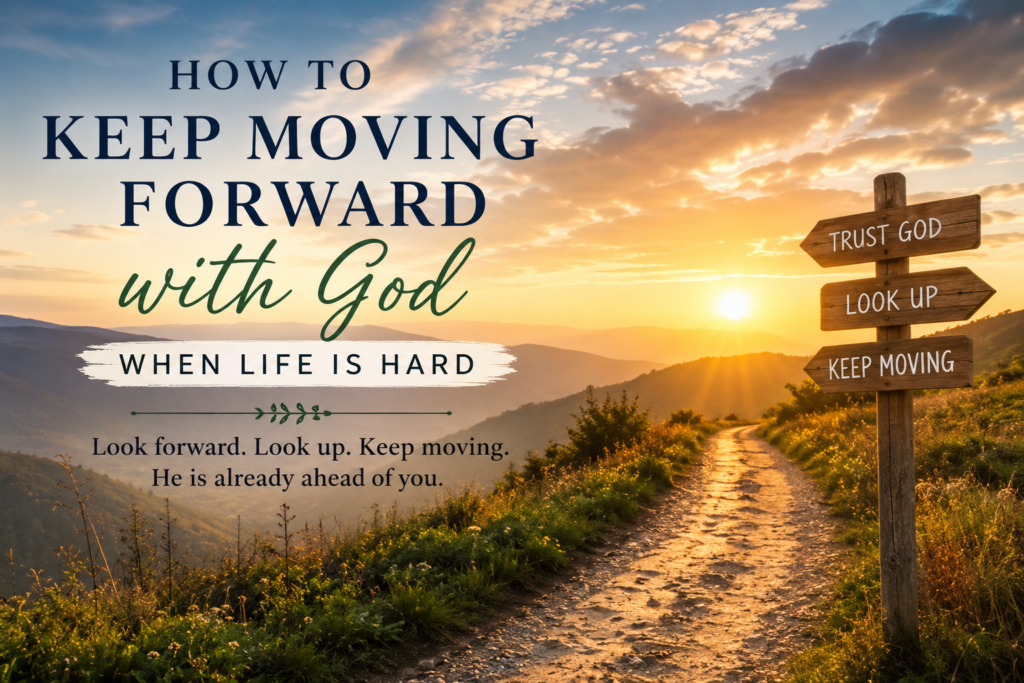
As I listened, one thought stood out to me: When life becomes difficult, we should keep moving forward with God rather than continually looking for an opportunity to look back.
Instead of looking back, we need to look up. That message spoke directly to where I am in my own life.
For the past twenty years, my journey has taken me along roads I could not have anticipated.
There were hardships, delays, unexpected turns, disappointments, and circumstances that required much of my time and energy. Yet through it all, the dreams and passions within me never disappeared.
I have continued moving forward.
Recently, however, I have sensed a turning point. There is a greater intentionality about how I am moving forward and where I am directing my attention.
I am increasingly aware that I cannot allow what has been—good or bad, comfortable or difficult—to determine where I go from here.
And Scripture gives us many examples of what it means to keep moving forward with God when life is hard.
Abraham | Moving Forward Without Knowing the Destination
God’s call to Abraham is recorded in Genesis 12:1:
“Get thee out of thy country, and from thy kindred, and from thy father’s house, unto a land that I will shew thee.”
Think about that.
God told Abraham to leave, but He did not hand him a map showing every stop along the way. Abraham knew Who had called him, but he did not know exactly where that call would take him.
Hebrews 11:8 describes it this way:
“By faith Abraham, when he was called to go out into a place which he should after receive for an inheritance, obeyed; and he went out, not knowing whither he went.”
He went out not knowing.
There is something powerful about those words.
We often want the opposite, to know first and then go. We want to understand how everything will work, where the resources will come from, what obstacles we will encounter, and how the story will end.
Then we will feel comfortable moving.
But faith sometimes requires us to move while there are still unanswered questions.
Abraham’s confidence could not rest in knowing the destination. It had to rest in knowing the God who was leading him.
The same is true for us.
I may not know where the road leads, but I can know the One who leads me.

When Hardship Makes Us Want to Go Back
Dr. Wiersbe also used the Children of Israel as an example.
God had delivered them from slavery in Egypt in one of the most extraordinary demonstrations of His power recorded in Scripture. Yet when they encountered difficulties in the wilderness, something strange happened.
They started talking about Egypt as though going back might be better.
In Exodus 14, with Pharaoh’s army approaching and the Red Sea before them, they asked Moses why he had brought them out of Egypt to die in the wilderness.
Later, their complaints became even more revealing. They remembered the food they had eaten in Egypt. Eventually, in Numbers 14, some of them wanted to appoint a leader and return.
Return to what?
Bondage.
Their present hardship was beginning to distort their memory of the past.
I think there is an important lesson there for us.
Sometimes what is familiar can begin to look attractive simply because what lies ahead is uncertain. We can remember selected portions of yesterday while forgetting why we needed deliverance, change, or growth in the first place.
The wilderness was difficult, but Egypt was not their destination. Neither was the wilderness. They had to keep moving.
We need to remind ourselves:
Don’t allow temporary hardship to make you long for something God has already brought you through.
Lot’s Wife | When Looking Back Has a Cost
Another example from the study was Lot’s wife.
When God was about to destroy Sodom and Gomorrah, Lot and his family were told to escape and not look behind them.
Genesis 19:26 records what happened:
“But his wife looked back from behind him, and she became a pillar of salt.”
Many years later, Jesus gave an extraordinarily brief warning:
“Remember Lot’s wife.”
—Luke 17:32
Three words.
Yet what a message they contain.
It is possible to leave something physically while still looking toward it emotionally, mentally, or spiritually.
There are experiences in our lives that should be remembered because they…
- Taught us
- Strengthened us
- Or became part of our testimony.
Moving forward does not require pretending our past never happened.
But there is a difference between remembering the past and facing the past.
I can acknowledge where I have been without continuing to face that direction.
Paul | Reaching for What Is Ahead
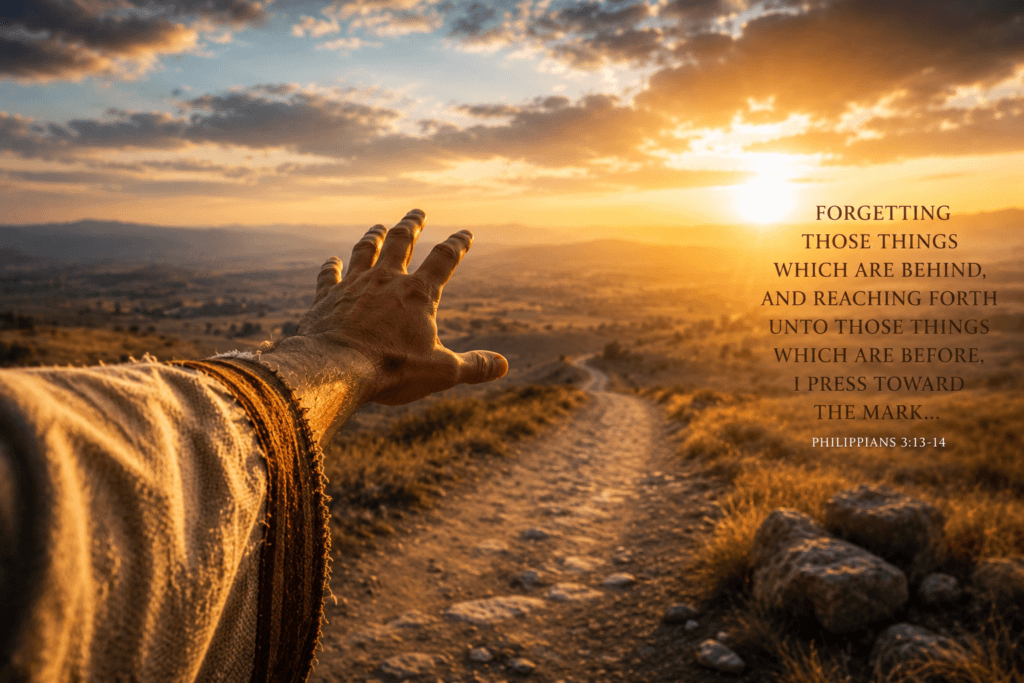
The apostle Paul gives us another perspective in Philippians 3:13–14:
“Forgetting those things which are behind, and reaching forth unto those things which are before, I press toward the mark…”
Paul had plenty behind him.
There were accomplishments he could have continued celebrating and experiences he might have continued regretting. Yet neither his successes nor his failures were going to become the place where he stopped.
He was reaching forward.
I don’t believe “forgetting” means that every memory of the past somehow disappears. Our experiences help shape us. They teach us. Sometimes they become the very means through which we can encourage someone else.
But the past is a terrible place to park when God is calling us forward.
My own twenty-year journey is part of my story. I don’t want to erase it. I couldn’t erase it if I tried.
There have been…
- Lessons I needed to learn
- Experiences I could never have planned
- People whose lives intersected with mine
- Opportunities that emerged unexpectedly
- And hardships that strengthened qualities I would later need.
I can carry those lessons forward without continually turning around to look at where they came from.
Peter | Sometimes We Need to Look Up
There is another biblical account that adds an important dimension to this subject.
Peter was in a boat with the other disciples when they saw Jesus walking on the water. Peter said:
“Lord, if it be thou, bid me come unto thee on the water.”
Jesus said one word:
“Come.”
And Peter went.
For a moment, he did the impossible. He walked on water toward Jesus.
But Matthew 14:30 tells us that when Peter saw the wind boisterous, he became afraid and began to sink.
Something about that has always fascinated me. The wind wasn’t new, and the storm had already been there when Peter stepped out of the boat.
What changed was where Peter directed his attention.
There will always be circumstances competing for our attention. We’ll face problems, financial pressures, disappointments, responsibilities, and unexpected changes.
Faith does not require pretending otherwise.
But those things don’t have to become the primary direction of our gaze.
Sometimes the answer to looking back isn’t merely looking forward.
It is looking up.
What If God Is Doing Something New?
Isaiah 43:18–19 gives us another reason not to become consumed with what is behind us:
“Remember ye not the former things, neither consider the things of old. Behold, I will do a new thing; now it shall spring forth; shall ye not know it?”
I love the question at the end:
Shall ye not know it?
Could we become so focused on what God did before—or what we wish had happened differently—that we fail to recognize what He is doing now?
For example, a new season does not announce itself dramatically.
Sometimes circumstances have not completely changed, yet something within us has.
- Our thinking may change.
- Priorities may become clearer,
- Maybe our willingness to release certain things increases.
- Or our determination becomes stronger.
And one day we recognize:
Something is different.
That is how I have been feeling lately.
I cannot tell you everything the next chapter will contain. I don’t know every road I will travel or every adjustment I will have to make along the way.
But I sense the importance of moving forward more intentionally.

Trusting God When I Don’t Know What’s Ahead
This brings me to a passage of Scripture that has been important throughout my journey:
“Trust in the LORD with all thine heart; and lean not unto thine own understanding. In all thy ways acknowledge him, and he shall direct thy paths.”
—Proverbs 3:5–6
We quote those verses easily.
Living them is another matter.
“Lean not unto thine own understanding” becomes especially meaningful when our understanding cannot tell us what happens next.
When we want answers, God asks for trust.
We want the complete plan, but sometimes God gives us the next step.
Likewise, we want to see the destination. God reminds us to keep our eyes on Him.
And perhaps that is one of the most important things I took away from that morning’s Bible study:
What is unknown to me is not unknown to God.
There is a tremendous difference between something being unknown and something being unplanned.
The road ahead may be unknown to me without being unplanned by God.
My Decision Is to Keep Moving Forward
When I think about the past twenty years, I don’t see twenty years in which I stopped pursuing my dreams.
Quite the contrary.
There are things I need to be occupied with in the meantime such as writing, creating, learning, developing ideas.
Similarly, I continued pursuing opportunities and building upon things that sometimes seemed to be moving far more slowly than I wanted.
Life happened alongside those dreams. So do responsibilities, hardships, and detours.
Most importantly, I still kept going.
That is why this current season doesn’t feel like a decision to suddenly begin moving forward.
It feels like a decision to move forward differently.
It’s a season to move more intentionally, deliberately, and more conscious of where I am directing my time, energy, attention, and faith.
I don’t need to spend the next chapter continually measuring it against the last one. Nor do I need to know exactly what the next twenty years—or even the next twenty months—will look like.
- Abraham didn’t know where he was going.
- The Israelites had to learn that difficulty was not a reason to return to Egypt.
- Lot’s wife reminds me not to keep looking behind me.
- Paul teaches me to reach toward what is ahead.
- Peter reminds me where to keep my eyes when the wind becomes distracting.
- Isaiah reminds me that God may already be doing something new.
- And Proverbs reminds me that I don’t have to understand the entire path in order to trust the One directing it.
So, I will keep moving and trusting.
I will carry forward the lessons, gratitude, wisdom, and even the scars from what has been. However, I will not allow yesterday to determine the direction of my gaze.
There is still more ahead. I don’t know exactly what it will look like. And that’s okay.
I will continue to keep my eyes on Him while He directs me into what is unknown to me, yet known and ordained by Him.
Look forward. Look up. Keep moving.

What About You?
Have you ever found yourself at a point where God was leading you forward, but you couldn’t see what was waiting ahead? Perhaps hardship tempted you to look back, or uncertainty made it difficult to take the next step.
I’d love to hear about your experience.
What has God taught you about trusting Him and continuing to move forward when life is hard? Is there a particular Scripture that has helped you keep your eyes on Him?
Share your thoughts and experiences in the comments below. Your story may be exactly the encouragement someone else needs as they face their own unknown road ahead.
Let’s encourage one another to look forward, look up, and keep moving.
Veron | Author & Entrepreneur | The Way 4Word Enterprises
- Share:
