What do you have in your hand? A reflection on faith, purpose, and the responsibility of using what God has entrusted to us.
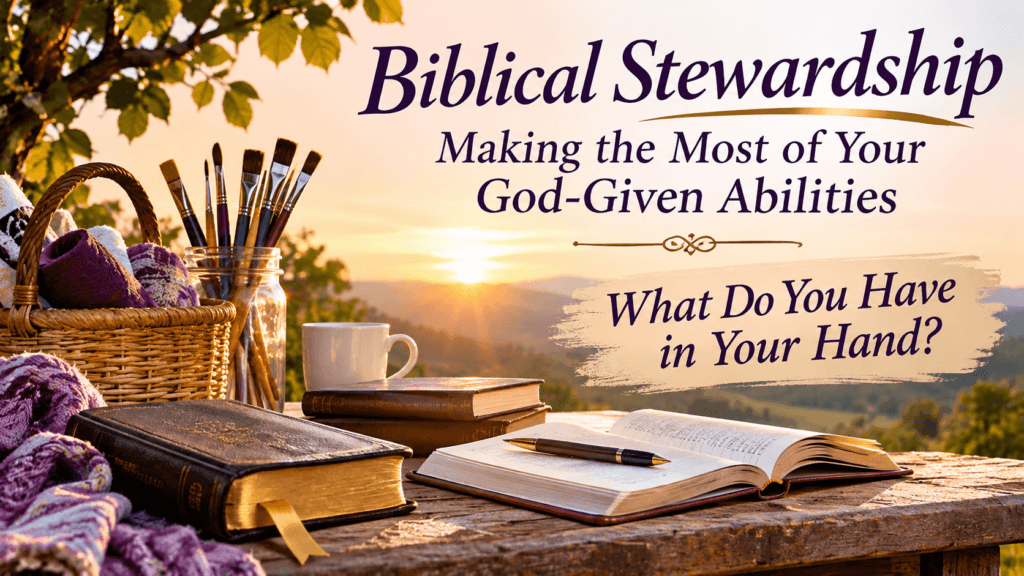
Circumstances in our lives can cause us to reflect more deeply on what we have, what we need, and how we move forward. Sometimes, we do not find the answers in acquiring something new but in recognizing the value of what has been within our reach all along.
Recently, while reconciling my weekly income with my budget, I found myself contemplating the financial realities of a significant change in my caregiving schedule.
After discontinuing overnight caregiving, my income had decreased considerably. Yet, I was grateful for what I continued to receive.
The decision had also given me something of considerable value: greater freedom to attend to my health, restore a healthier sleep pattern, and devote meaningful time to the creative and entrepreneurial pursuits I had cultivated throughout my life.
As I considered my circumstances, a familiar question came to mind:
“What do you have in your hand?”
The question was not new to me. Neither was the principle behind it. Throughout my life, I have recognized the importance of using the abilities, knowledge, and opportunities God has entrusted to me.
But on this occasion, the question carried a renewed sense of urgency. It was more than a reminder. I experienced it as a prompting to continue moving forward.
That reflection brought several biblical accounts to mind, each illustrating a different dimension of stewardship.
What Is Biblical Stewardship?
Biblical stewardship is the faithful and responsible management of what God has entrusted to our care.
Although stewardship is frequently associated with finances and material possessions, its meaning extends much further.
Our time, abilities, knowledge, experiences, relationships, opportunities, and physical well-being are also resources that require thoughtful management.
In Luke 12:48, Jesus teaches:
“For unto whomsoever much is given, of him shall be much required.”
This Scripture has long held personal significance for me.
I believe that the many abilities I have developed throughout my life carry both opportunities and responsibilities. They are not simply resources for personal advancement or financial gain. They also provide opportunities to serve others and contribute meaningfully to humanity.
However, faithful stewardship does not mean that every ability must be exercised every day or that every opportunity must be pursued.
Sometimes stewardship involves developing one ability while another rests. Sometimes it means preserving a skill until an appropriate opportunity arises. At other times, it requires recognizing that our health, peace, and physical capacity are themselves resources worthy of care.
Wisdom is essential in determining how, when, and where our abilities can be most effectively used.
Moses’ Rod | Recognizing What Is Already in Your Hand
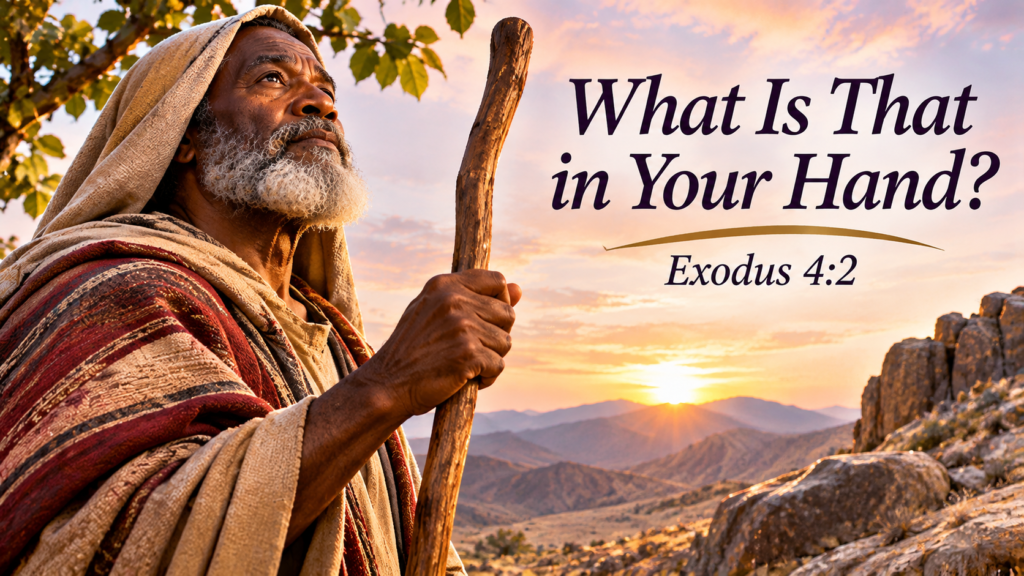
In Exodus 4, when God called Moses to undertake a tremendous responsibility, He asked him a seemingly simple question:
“And the LORD said unto him, What is that in thine hand? And he said, A rod.” — Exodus 4:2 (KJV)
Moses was holding something familiar. His rod was an ordinary instrument associated with his daily life as a shepherd.
Yet, in God’s hands, that ordinary instrument would become part of an extraordinary assignment.
The significance of this account is not that Moses possessed something impressive. Rather, God directed his attention to something he already had.
This is where the question becomes particularly meaningful to me.
Over the years, I have developed abilities in writing, caregiving, entrepreneurship, nail artistry, fabric crafts, interior decorating, and other creative pursuits.
These are not newly discovered interests. They have been part of my life for decades, cultivated through education, professional experience, personal initiative, and countless hours of practical application.
Some have been more active than others during particular seasons, but they have never ceased to be part of who I am.
As I considered the possibilities before me, I recognized that I did not need to begin by searching for an entirely different purpose.
I could begin with what was already in my hand.
This principle extends beyond professional or creative abilities. Someone may possess knowledge gained through difficult experiences, the ability to encourage others, practical skills developed through years of work, or wisdom acquired through life’s challenges.
What appears ordinary or familiar to us may have greater significance than we realize.
The question is not always what we lack, but what we can faithfully do with what we already possess.
Peter’s Fishing Net | Acting in Faith With What You Have
Another biblical account that came to mind was Peter’s experience in Luke 5:1–11.
Peter and his fellow fishermen had worked throughout the night without catching anything. When Jesus instructed Peter to let down his nets again, Peter acknowledged their unsuccessful efforts but responded:
“Nevertheless at thy word I will let down the net.” — Luke 5:5 (KJV)
What followed was an extraordinary catch of fish.
During an earlier reflection on my various abilities and projects, I spontaneously envisioned a wide fishing net.
I described it this way:
“They’re already there in existence, but I’m reeling them in using a wide net.”
The image represented the many dimensions of my life’s work.
I was not imagining myself searching for new talents or pursuing unfamiliar interests simply to create additional opportunities. Instead, I saw myself gathering together what had already been cultivated.
My writing, professional knowledge, creative abilities, and entrepreneurial experience have developed through different circumstances and seasons. Although they may appear unrelated at first glance, they are connected through one life and one overarching vision.
The fishing net analogy also reminded me that having the necessary tools or abilities does not eliminate the need for faith, discernment, and action.
Peter had the experience, the boat, and the nets. Yet the outcome changed when he responded to the Lord’s instruction.
Similarly, I recognize that possessing abilities does not automatically produce the results I desire. There must be purposeful action, sound judgment, perseverance, and a willingness to respond appropriately as opportunities unfold.
Not every effort will yield an immediate return. Neither will every open door lead where we expect.
Nevertheless, faith encourages us to continue acting responsibly with what has been entrusted to us.

Ruth’s Gleaning | Gathering the Harvest Over Time
As I continued reflecting on the fishing net, another biblical image emerged: Ruth gleaning in the field of Boaz.
In Ruth 2, we encounter a woman whose circumstances required her to seek provision through diligent work.
Ruth went into the fields to gather grain left behind by the harvesters. She worked with the opportunity available to her, without knowing the full significance of how her circumstances would unfold.
Her experience illustrates diligence, humility, patience, and the provision that can emerge through faithful action.
As I considered her example, I expressed another thought:
“The gleaning isn’t done all at once; it takes time, and it takes many hands.”
I then reflected on the fact that, although I might not require many people to participate in my undertakings, the Lord has blessed me with many different skills.
Each ability represents something developed, practiced, or preserved throughout my life.
Some may produce opportunities sooner than others. While some may be better suited to particular audiences, circumstances, or seasons.
And some may remain in the background until the appropriate time.
The analogy of gleaning reminds me that a harvest does not necessarily have to be gathered all at once.
This is especially relevant as I continue developing The Way 4Word Enterprises, an undertaking that brings together my writing, professional experience, and creative expressions.
I am not attempting to make every project productive simultaneously. I am working with the opportunities and resources available to me while remaining attentive to what may develop next.
There is a meaningful distinction between allowing something to remain idle through neglect and preserving it intentionally until the time is right.
Both patience and diligence have their place in stewardship.
Stewardship Requires Wisdom, Not Constant Activity
One of the most important lessons I have drawn from these reflections is that stewardship should not be confused with constant productivity.
Having multiple abilities does not obligate us to exercise them all at the same time.
Throughout my life, creative expression has come naturally to me. Writing, designing, making things, and developing ideas have enriched my life and, I trust, the lives of others.
These pursuits have not generally been a source of exhaustion. Rather, they have provided opportunities for personal fulfillment, service, and meaningful engagement.
By contrast, the physical demands of caregiving have sometimes required considerable sacrifice.
I have remained committed to that responsibility, but I also recognize the importance of preserving my health and physical capacity.
This understanding influenced my decision to discontinue overnight caregiving.
Although the resulting reduction in income was substantial, the change created greater opportunities to rest, attend to my health, and devote time to other meaningful pursuits.
It was not a decision to abandon responsibility. Instead, it was an acknowledgment that responsibility includes making thoughtful choices about how our resources are used.
Stewardship requires us to consider not only what we are capable of doing but also what is appropriate and sustainable in our present circumstances.
I pray daily for wisdom, knowledge, and understanding recognizing that possessing abilities and knowing how best to use them are not necessarily the same thing.
The goal is not simply to remain busy.
The goal is to remain faithful in the use of what God has entrusted to our care.
Waiting Upon the Lord While Moving Forward
Recently, as I reconciled another expected meager weekly caregiving deposit with my budget, the question returned:
“What do you have in your hand?”
I was fully aware of the financial challenges before me. Yet, my attention also turned to the projects I was developing, the knowledge I possessed, and the opportunities I could continue exploring.
Rather than becoming discouraged by what was missing, I felt encouraged to continue working with what was available.
That experience brought Isaiah 40:31 to mind:
“But they that wait upon the LORD shall renew their strength; they shall mount up with wings as eagles; they shall run, and not be weary; and they shall walk, and not faint.” (KJV)
Waiting upon the Lord does not necessarily mean remaining inactive.
There are times when waiting involves…
- Continuing to fulfill our responsibilities
- Developing what is within our reach
- Exercising patience
- And trusting God with outcomes we cannot control.
I find particular encouragement in the closing words of this verse:
“They shall walk, and not faint.”
Not every season requires extraordinary accomplishments or dramatic breakthroughs.
Sometimes the responsibility before us is simply to continue walking faithfully, one step at a time.
The ability to persevere, even when progress appears gradual, is itself a blessing.
My present circumstances have not removed the financial realities I must address. Nor do I assume that every project will automatically become successful because I have invested time and effort in it.
I continue to work, produce, learn, evaluate opportunities, and make decisions according to the resources available to me.
At the same time, I trust that the Lord will provide the wisdom and strength necessary for the journey.
Faith and purposeful action are not opposing principles.
They can work together as we seek to fulfill our responsibilities.
Bringing the Fruits of a Lifetime Into Greater Use
As I reflect on these biblical accounts, I recognize a common thread.
- Moses was directed to what he already held.
- Peter was instructed to use the equipment and experience already familiar to him.
- Ruth worked diligently with the opportunity available to her.
- The teaching in Luke 12:48 reminds us of the responsibility accompanying what we have received.
- And Isaiah 40:31 offers encouragement to those who continue trusting the Lord through seasons of waiting.
Each account speaks to a different aspect of the journey. However, together they reinforce the importance of recognizing, developing, preserving, and wisely using what has been entrusted to us.
For me, this is not about discovering who I am or learning for the first time to appreciate my abilities.
It is about bringing the fruits of a lifetime of stewardship into greater productive use.
My circumstances have changed, but the resources I have cultivated over many years remain.
The opportunities ahead may take different forms from those I have previously experienced. Some may provide financial returns, while others may offer opportunities to serve, encourage, teach, or contribute creatively.
Both have value.
The challenge is to exercise wisdom in determining which opportunities to pursue, which to preserve for another time, and which may no longer be appropriate.
That, too, is stewardship.

What Do You Have in Your Hand?
Perhaps you are facing circumstances that have caused you to reconsider your direction.
You may be approaching retirement, navigating a career transition, experiencing financial challenges, or simply wondering how to make more meaningful use of the abilities and experiences you have accumulated.
Before concluding that you must begin something entirely new, consider what may already be within your reach.
- What knowledge have you acquired?
- What abilities have you developed?
- What experiences have equipped you to help others?
- What opportunities have you overlooked because they seemed too ordinary or familiar?
- And what resources might you need to preserve, develop, or use differently in this season of your life?
The answers will not be the same for everyone.
Neither will the timing, opportunities, or outcomes.
But the principle remains worthy of consideration.
Biblical stewardship invites us to recognize that what we possess carries responsibility and potential. It challenges us to exercise wisdom, act faithfully, and trust God as we move forward.
As I continue reflecting on my own journey, three thoughts remain with me:
- The circumstances remind me of the need.
- The question reminds me of the resources.
- And the prompting strengthens my resolve to continue.
I do not know precisely how every opportunity before me will unfold.
But I know that I am not starting with empty hands.
And perhaps that is where the next chapter of faithful stewardship begins.
What do you have in your hand? Feel free share in the comments below.
- Share:
